
Full-time childcare. Meal planning and cooking. School pickups and drop-offs. Household management. Emotional support for your kids. That's not one job — it's six or seven, running simultaneously, seven days a week. The cost to outsource all of it would be substantial, and it would hit immediately, while you're still grieving.
According to LIMRA and Life Happens' 2024 research, 42% of American adults either need life insurance or need more of it — roughly 102 million people. Many stay-at-home parents fall directly into that gap.
This guide covers the real financial value of a stay-at-home parent, what a life insurance payout would actually fund, how much coverage makes sense, and how to take the first step.
Key Takeaways
- A stay-at-home parent's unpaid labor has been estimated at over $184,000 per year when priced at professional market rates
- Losing a stay-at-home parent creates immediate, ongoing costs — childcare, household help, tutoring, and more
- Life insurance for a stay-at-home parent replaces services, not income
- Coverage of $250,000–$400,000 with a 15- to 20-year term is a common starting point
- Premiums are lowest when you're young and healthy — waiting increases cost and risk
The Hidden Financial Value of a Stay-at-Home Parent
The income-replacement framing of life insurance creates a blind spot. If someone doesn't earn a paycheck, the thinking goes, there's no income to replace. But life insurance isn't only about income — it protects against financial hardship. And the sudden absence of a stay-at-home parent creates plenty of that.
Think about what a stay-at-home parent actually does on a given weekday:
- Childcare and supervision throughout the day
- Meal planning, grocery shopping, and cooking
- Driving children to school, activities, and appointments
- Managing household finances, scheduling, and appointments
- Tutoring and homework support
- Laundry, cleaning, and household maintenance
- Emotional caregiving for children and the family
That's not a single role — it's a CFO, logistics coordinator, private chef, childcare provider, and housekeeper rolled into one person, seven days a week.
The Dollar Value Behind the Work
Salary.com's survey of over 19,000 mothers put the annual value of a stay-at-home parent's labor at $184,820 — based on market rates for more than 20 professional roles and over 106 hours of work per week. A 2024 Forbes report citing a study across 80 major cities put the monthly figure at $4,000 to $5,200, depending on family size.
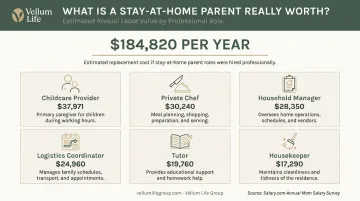
If the stay-at-home parent were gone, the surviving spouse would need to hire real people at real market rates — while working full time and managing grief. Those costs arrive immediately, regardless of whether a policy exists to cover them.
What Can Life Insurance Cover for a Stay-at-Home Parent?
A life insurance payout here serves a concrete purpose: funding the services the family will need immediately and throughout the years that follow.
Childcare Costs
This is the biggest line item. According to Child Care Aware of America's 2025 analysis, the national average annual cost of childcare is $13,184. Care.com's 2026 Cost of Care Report puts full-time center daycare at $332 per week for one infant and full-time nanny care at $870 per week — meaning a nanny for one child runs over $45,000 per year.
These costs are per child and persist for years. For a family with two young children, the total childcare exposure over a decade can easily exceed $200,000.
Household Help and Daily Operations
A working single parent can't also clean the house, mow the lawn, and prep every meal. These tasks become paid services out of necessity, not luxury:
- House cleaning runs $118–$238 per visit, or $200–$800/month on a recurring schedule (Angi, 2026)
- Lawn care adds $100–$500/month for ongoing maintenance
- Grocery delivery and meal kit services typically cost $150–$400/month depending on family size and provider
Together, these recurring services add up to $1,500–$3,000 or more per month.
Children's Education and Extracurricular Support
For families who homeschool, the transition to a traditional school setting adds immediate tuition costs. Private K–12 tuition averages $12,790 per year nationally. For families already enrolled in private school, life insurance funds help ensure those plans don't have to change.
Youth sports and extracurricular activities add another layer — families spent an average of $1,016 on a child's primary sport alone in 2024, according to the Aspen Institute's Project Play survey.
Emotional and Mental Health Support
Beyond the financial logistics, grief counseling for children and the surviving spouse is a real cost that often goes unplanned. Therapy sessions typically run $100–$200 per session in the U.S., with grief counseling often falling in the $75–$150 range. Evidence-based grief interventions for bereaved children commonly span 6–12 sessions — meaning a full course of support can run $900–$1,800 per child. Having funds earmarked for this prevents families from skipping care they genuinely need.
Time and Transition for the Surviving Spouse
There's also the cost of time. Financial pressure can force a grieving parent back to work before they're ready — before school logistics are sorted, before routines stabilize, before children have had time to adjust. A life insurance payout removes that pressure, buying weeks or months to focus on the family first.
How Much Life Insurance Does a Stay-at-Home Parent Need?
Most advisors recommend a $250,000–$400,000 policy with a 15- to 20-year term as a solid starting point — but the right number depends on your family's specific situation.
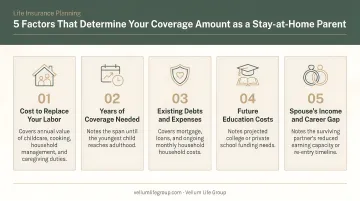
Key Factors That Determine Coverage Amount
- Children's ages and count: More kids — especially young ones — means higher childcare costs over a longer stretch. A family with a newborn and a 4-year-old needs substantially more coverage than one whose youngest is 11.
- Local childcare costs: The Department of Labor reports full-day childcare ranging from $6,552 to $15,600 annually by region. A family in San Francisco or New York faces a very different financial exposure than one in a rural area.
- Return-to-work timeline: If the stay-at-home parent plans to re-enter the workforce in five to seven years, the policy should cover that window. Locking in coverage now also secures a lower premium while younger and healthy.
- Household financial obligations: Private school, mortgage balance, extracurriculars, and existing savings all affect the right coverage amount. A policy that looks adequate in isolation can fall short against a family's actual lifestyle.
- Final expenses: Funeral and burial costs typically run $8,000–$12,000 — an immediate expense that life insurance can absorb so the surviving spouse isn't managing logistics and finances at the same time.
What Type of Life Insurance Is Best for Stay-at-Home Parents?
Term life insurance is the most practical choice for most stay-at-home parents. It covers the specific period when the family is most financially exposed — the child-raising years — with straightforward death benefit protection at the lowest premiums.
Policygenius rate data from October 2024 shows a 30-year-old female can obtain $250,000 in 20-year term coverage for roughly $15/month. At age 40, that same policy runs about $22/month — still modest, but meaningfully higher. Waiting costs real money.
Whole life and universal life insurance suit families with different goals:
- Whole life: Permanent coverage with a guaranteed cash value component; higher premiums, but the policy never expires
- Universal life: More flexible premiums and adjustable death benefits; useful for long-term estate or legacy planning
- Term: Lowest cost, fixed coverage period — the right fit for most families protecting against income loss during the child-raising years
Because the options vary significantly in cost and structure, comparing them side by side matters.
An independent advisor with access to multiple carriers — like Vellum Life Group, which works with 10+ A-rated insurers — can match the right policy type to a family's specific budget, timeline, and goals, rather than fitting every situation into one product.
How to Get Life Insurance as a Stay-at-Home Parent
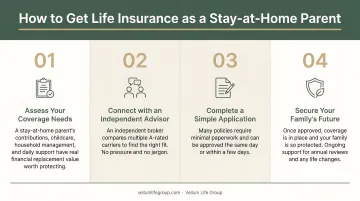
Getting coverage as a stay-at-home parent takes four steps — and most families move faster than they expect.
- Determine your coverage needs — Consider your children's ages, local childcare costs, household obligations, and how long you need coverage. The $250,000–$400,000 range is a common starting point, but your situation may call for more.
- Work with an independent advisor — An advisor with access to multiple carriers can compare options and identify the best fit for your health profile and budget.
- Complete an application — This includes questions about health history, lifestyle, and family situation. Honest answers lead to the most accurate underwriting.
- Receive approval — Many policies are approved the same day or within a few days. Some require a medical exam, which typically adds 2–4 weeks.
Non-working spouses can and do qualify for life insurance. Most insurers set coverage limits for non-earning applicants based on the working spouse's policy amount and the household's overall financial picture. An independent advisor can help navigate those guidelines and identify carriers with the most favorable terms for your profile.
Vellum Life Group offers a free, no-obligation consultation where families can walk through their options without pressure — no jargon, no sales pitch, just a clear look at what makes sense for your household.
Frequently Asked Questions
Should a stay-at-home parent have life insurance?
Yes. Life insurance for a stay-at-home parent covers the real cost of childcare, household management, and daily operations the surviving spouse would need to pay for. The financial impact of losing a stay-at-home parent is substantial and immediate.
Can I get life insurance with a pre-existing condition or while taking prescription medication?
Many people with pre-existing conditions can still qualify for life insurance, though premiums and terms vary by condition and carrier. Work with an advisor who can shop your health profile across multiple carriers to find the best available rates.
How much life insurance does a stay-at-home parent need?
A $250,000–$400,000, 15- to 20-year term policy is a reasonable starting point for many families. The right amount depends on how many children you have, local childcare costs, your regional cost of living, and whether the stay-at-home parent plans to re-enter the workforce.
What type of life insurance is best for a stay-at-home parent?
Term life insurance is typically the most affordable and practical option for the child-raising years, offering meaningful protection at the lowest premiums. Whole or universal life may be worth considering for families with permanent coverage needs or cash value goals.
Is life insurance expensive for a stay-at-home parent?
Term life insurance is affordable for most young, healthy applicants. Policygenius data shows a 30-year-old can secure $250,000 in 20-year term coverage for around $15/month. Rates increase with age, so locking in coverage sooner means a lower premium for the full term.
Does a stay-at-home parent need to have a job to qualify for life insurance?
No. Non-working spouses can qualify for life insurance, typically up to a coverage limit tied to the working spouse's policy or the household's overall financial needs. An independent advisor can identify which carriers offer the most competitive terms for non-earning applicants.